
For busy adults, finding time for a full workout often feels impossible. Between career demands, family obligations, and the daily commute, an hour at the gym can slip away. That is why 15-minute strength training has emerged as a compelling option. In 2026, the conversation around short-duration workouts has moved beyond convenience into real results. FIT CLUB, a private strength training studio that opened in Potomac Village in April 2026, is at the center of this shift. Using adaptive resistance machines and one-on-one coaching, the studio delivers a full-body session in 15 minutes that surpasses the muscle-building effect of a much longer traditional workout.
The Science Behind 15-Minute Strength Training
Strength training is not measured solely by time spent in the gym. The key drivers of muscle adaptation are mechanical tension, metabolic stress, and muscle damage, all of which can be achieved in a short, intense session when the resistance is properly applied. Traditional gym routines often include long rest periods and isolation exercises that extend total workout time without proportional benefit. In contrast, a 15-minute session can be highly effective if it targets multiple muscle groups with continuous, controlled effort.
FIT CLUB’s approach is built on adaptive resistance technology. The machines adjust resistance in real time to each user, ensuring that every repetition is performed at an optimal load. This eliminates the need for manual weight adjustments and allows the trainer to focus on form and intensity.
What Research Says About Short Workouts
Scientific literature supports the idea that high-intensity, time-efficient strength training can produce meaningful gains. Studies on low-volume, high-load protocols have shown that even brief resistance sessions performed regularly can increase muscle strength and size in adults. The general principle of progressive overload applied in a focused 15-minute window is consistent with established exercise physiology. The key variables are intensity, frequency, and consistency, not duration alone.
How Adaptive Resistance Technology Works
FIT CLUB’s adaptive resistance machines are computer-controlled and data-tracked. Unlike traditional weight stacks or free weights, these machines automatically adjust the resistance during each repetition based on the user’s force output. If you push harder, the machine responds with more resistance; if you fatigue, it backs off slightly. This creates a constant challenge that aligns with your instantaneous strength curve, which is difficult to replicate with conventional equipment.
The technology also records performance data session after session. Trainers can review your progress, identify weak points, and modify the workout plan accordingly. This data-driven approach supports measurable progress, which is a central part of FIT CLUB’s value proposition. According to the MoCo Show announcement, the studio focuses on “precision, efficiency, and measurable progress,” distinguishing itself from traditional gyms that may lack personalized tracking.
For the user, the experience is straightforward: show up, work with a certified personal trainer for 15 minutes, and let the machine adapt to your effort. There is no need to change plates or wait for equipment. The session is private, meaning the studio space is dedicated to you alone, no crowded floors, no mirrors full of other people.
Real Results for Adults Over 40 and Seniors
FIT CLUB’s studio in Potomac is particularly well-suited for adults over 40 and seniors concerned about age-related muscle loss, a condition known as sarcopenia. Muscle mass naturally declines by about 3–8% per decade after age 30, and the rate accelerates after 60. Strength training is the most effective countermeasure, but many older adults avoid traditional gyms due to intimidation, safety concerns, or time constraints.
The 15-minute format addresses these barriers. Because sessions are short, they fit easily into a lunch break or a quick errand. Because the machines are adaptive and the trainer is present, the risk of injury from improper form is reduced. The studio aims to help members build muscle, improve balance, and support long-term health. For those returning to exercise after a break or an injury, the guided, low-judgment environment can be especially welcoming.
FIT CLUB offers free trial sessions, allowing potential members to experience the system before committing. This low-risk entry point is ideal for anyone curious about whether 15-minute strength training can meet their needs.
A New Standard for Efficiency
Comparing FIT CLUB’s 15-minute workouts to traditional gym routines reveals key differences. The table below summarizes the main contrasts based on information from the studio’s website and the MoCo Show announcement.
Comparing FIT CLUB’s 15-minute workouts to traditional gym routines reveals key differences. The table below summarizes the main contrasts based on information from the studio’s website and the MoCo Show announcement.
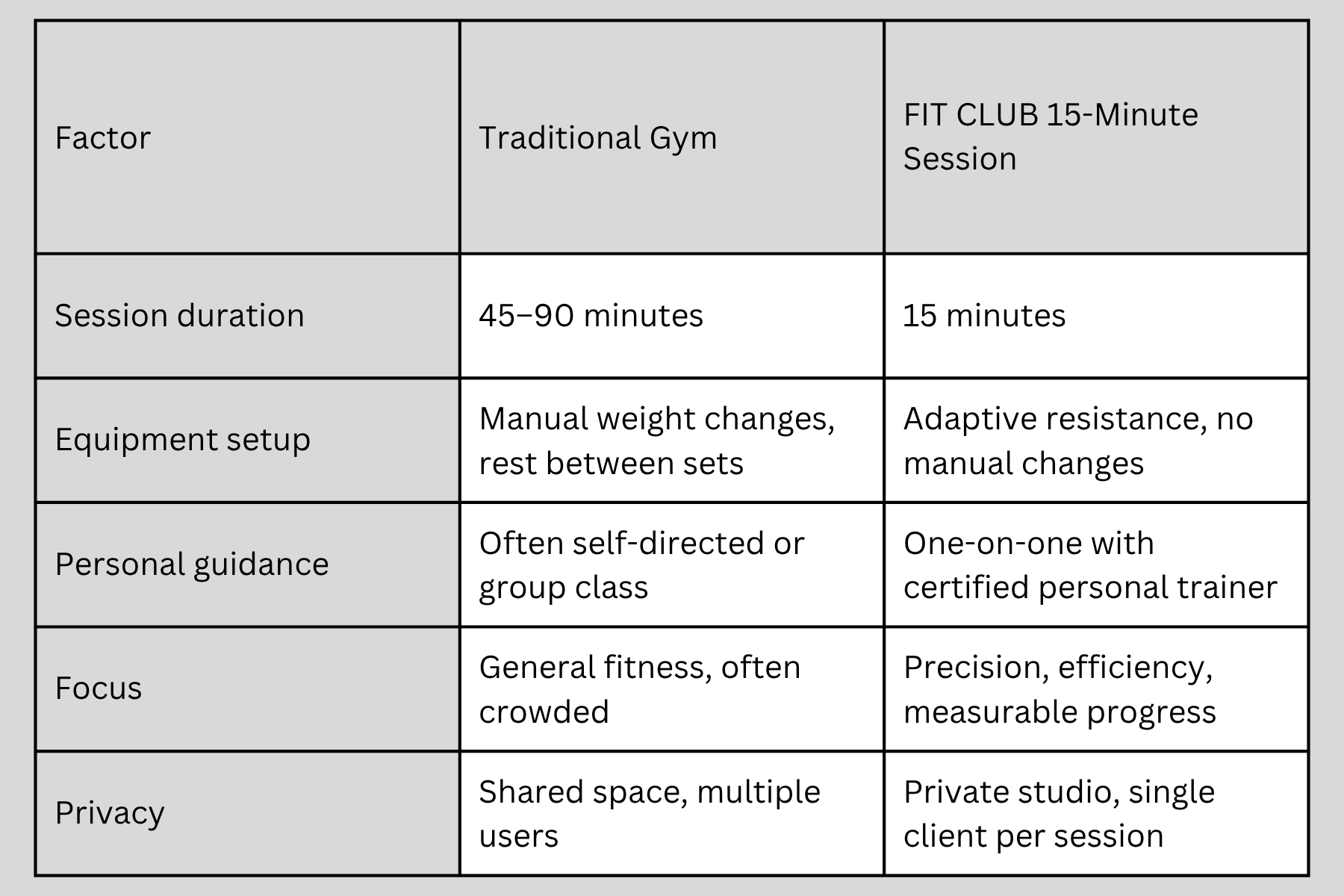
FIT CLUB vs Traditional Gym
FIT CLUB's 15-minute session delivers results equivalent to an hour or more at a traditional gym. While individual results vary, the company’s premise is that time efficiency combined with technology and professional coaching removes many obstacles that keep people from exercising consistently.
The FIT CLUB Difference in Potomac
FIT CLUB positions itself as a solution for those who want to prioritize strength training without sacrificing their schedule. The private nature of the sessions also appeals to people who prefer not to work out in a public gym environment.
For anyone considering a 15-minute strength training program in Potomac, FIT CLUB offers a free trial. This provides a firsthand look at the adaptive resistance machines, the coaching style, and whether the results align with personal goals. Prospective members are encouraged to contact the studio for current membership options, as specific pricing is not publicly listed.
Frequently Asked Questions
How does a 15-minute strength training session work?
In a 15-minute session, you work one-on-one with a certified personal trainer using adaptive resistance machines. The machine adjusts resistance in real time based on your effort, so every rep is challenging. The trainer guides you through a full-body routine that targets all major muscle groups without wasted time.
Is 15 minutes of strength training enough to build muscle?
Yes. When the workout is structured with proper intensity and progressive overload, a focused 15-minute session can stimulate muscle growth and strength gains. Consistency is key. FIT CLUB's 15-minute sessions produce results equivalent to much longer traditional workouts, based on the efficiency of its technology and coaching.
Who is the 15-minute strength training program suitable for?
The program is designed for anyone who wants to build, preserve or counteract muscle loss, as well as busy professionals seeking time-efficient workouts. It is also appropriate for people returning to exercise after an injury or a long break because sessions are private and guided. The adaptive machines reduce the risk of injury from improper form.
What results can I expect from 15-minute strength training?
Individual results depend on factors like frequency, nutrition, and starting fitness level. FIT CLUB states that its system helps members build muscle, improve balance, and support long-term health. The studio tracks data to show measurable progress over time. A free trial session can help you see how the workout feels and whether it fits your goals.
Whether you are in your thirties, forties, or beyond, the idea of committing to 15-minute strength training sessions in Potomac is worth exploring. The combination of adaptive resistance technology, certified personal trainers, and a private studio removes many common excuses. With a free trial available, the only way to truly evaluate the results is to experience them firsthand at FIT CLUB Potomac.